Hello ,
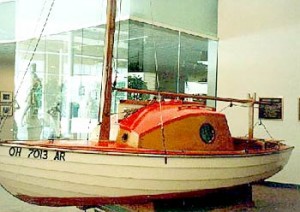
On May 24, 1965, a thirteen-and-a-half-foot boat quietly slipped out of the marina at Falmouth, Massachusetts. Its destination? England. It would be the smallest craft ever to make the voyage. Its name?
Tinkerbelle.
Its pilot? Robert Manry, a copy editor for the Cleveland Plain Dealer, who felt ten years at the desk was enough boredom for a while, so he took a leave of absence to fulfill his secret
dream.
Manry was afraid, not of the ocean, but of all those people who would try to talk him out of the trip. So he didn't share it with many, just some relatives and especially his wife, Virginia. She was his
greatest source of support.
The trip? Anything but pleasant. He spent sleepless nights trying to cross shipping lanes without getting run down and sunk. Weeks at sea caused his food to become tasteless. Loneliness, that age-old monster
of the deep, led to terrifying hallucinations. His rudder broke three times.
Storms swept him overboard, and had it not been for the rope he had knotted around his waist, he would never have been able to pull himself back on board. Finally, after seventy-eight days alone at sea, he
sailed into Falmouth, England.
During those nights at the tiller, he had fantasized about what he would do once he arrived. He expected simply to check into a hotel, eat dinner alone, then the next morning see if, perhaps, the Associated
Press might be interested in his story. Was he in for a surprise!
Word of his approach had spread far and wide. To his amazement, three hundred vessels, with horns blasting, escorted Tinkerbelle into port. Forty thousand people stood screaming and cheering him to shore.
Robert Manry, copy editor turned dreamer, became an overnight hero.
His story has been told around the world. But Robert couldn't have done it alone. Standing on the dock was an even greater hero: Virginia. Refusing to be rigid when Robert's dream was taking shape, she
allowed him freedom to pursue his dream.
I've often wondered what God's people would seek to accomplish for His kingdom if we knew that we could not fail. What would we do if, like Robert Manry, we could actually believe (despite the seemingly
impossible hurdles), that we serve a God of impossibilities, and that belief was backed up by action?
"There is no fear in love; but perfect love casts out fear, because fear involves torment. But he who fears has not been made perfect in love." 1 John 4:18 (NKJV)
If we serve an all-powerful God, why are we so often afraid?
Have a great day and God bless!
Pastor Mike / The Open
Word